
How We Test Every Flashlight Before It Leaves Our Line
Summary: Every flashlight we manufacture passes through a rigorous quality control process before leaving our facility. Testing includes function verification, beam pattern analysis, waterproof validation, and drop testing. Understanding this process helps buyers evaluate any manufacturer’s commitment to quality.
Introduction
When you place a flashlight order, you assume the supplier has checked every unit before shipping. The reality is that many factories skip testing entirely or perform only a cursory visual inspection. At our facility, every flashlight undergoes a multi-stage quality control process that takes longer than the assembly itself.
This article walks you through exactly how we test every flashlight, what equipment we use, and what happens to units that fail. Use this as a benchmark when evaluating any flashlight manufacturer.
Stage 1: Incoming Material Inspection
Quality control starts before assembly begins. Every batch of LEDs, batteries, switches, and aluminum bodies is inspected upon arrival. We check:
- LED forward voltage and color temperature against specifications
- Aluminum body dimensions and surface finish quality
- Battery capacity and internal resistance
- Switch actuation force and electrical continuity
Materials that fail incoming inspection are returned to the supplier before they enter production. This prevents defects from reaching the assembly line.
Stage 2: In-Process Testing
During assembly, workers perform self-checks at each station. The driver installer verifies soldering quality with a magnifying glass. The LED assembler checks alignment with a jig. The body assembler confirms thread engagement smoothness.
Each workstation has a pass/fail checklist. If a unit fails at any station, it moves to a repair queue instead of continuing down the line. This prevents compounding defects.
Stage 3: Functional Testing
After assembly, every flashlight is powered on and cycled through all brightness modes. We verify:
- Mode switching functions correctly (high, medium, low, strobe, SOS)
- Brightness output is within 10% of specification
- Run-time at maximum output meets the rated duration
- Thermal regulation activates properly to prevent overheating
This testing uses calibrated light meters and electronic loads. Results are recorded by batch number for traceability.
Stage 4: Mechanical and Environmental Testing
Functional units move to mechanical testing:
- Drop test: 1-meter drop onto concrete from 6 orientations
- Waterproof test: IPX4 spray test or IPX7 submersion test
- Switch durability: 10,000 actuation cycles
- Thread wear: 100 open/close cycles of tail cap
Only units passing all mechanical tests proceed to final inspection.
Stage 5: Final Visual Inspection
A dedicated inspector examines every flashlight under bright light for:
- Anodizing defects, scratches, or color inconsistency
- Lens cleanliness and absence of internal dust
- Logo print quality and alignment
- Packaging completeness and label accuracy
This is the last chance to catch cosmetic defects before the product reaches the customer.
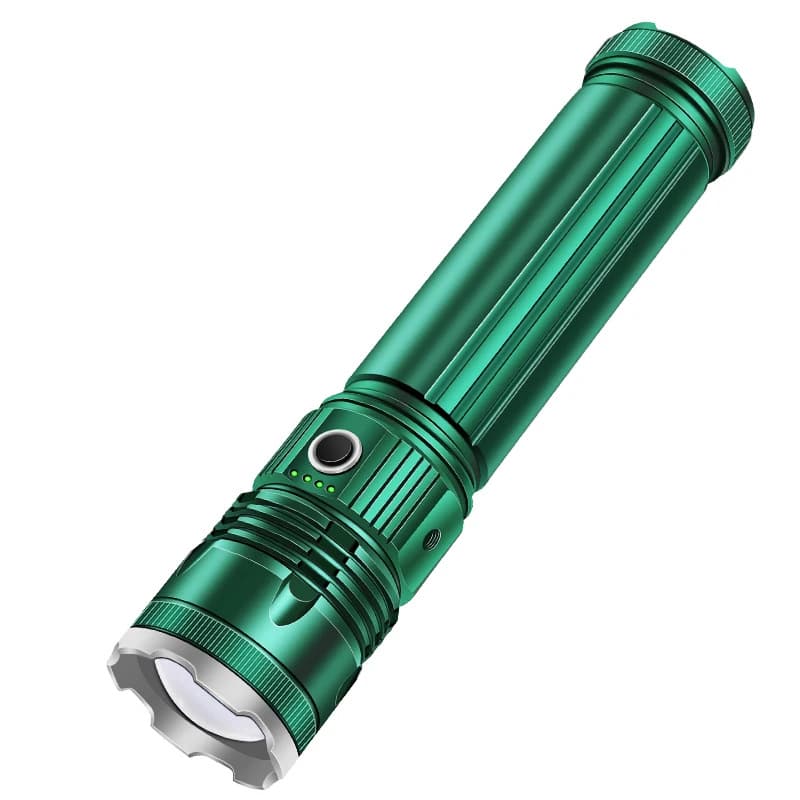
Testing Equipment We Use
| Equipment | Purpose | Calibration Frequency |
|---|---|---|
| Integrating sphere | Lumen output measurement | Annual |
| Digital lux meter | Beam intensity testing | Semi-annual |
| Electronic load | Run-time verification | Annual |
| Thermal chamber | Operating temperature testing | Annual |
| Waterproof test tank | IP rating verification | Not applicable |
| Drop test fixture | Impact resistance | Not applicable |
What Happens to Failed Units
Not every flashlight passes. Units that fail are categorized:
- Repairable: Minor defects fixed and retested
- Component scrap: Salvageable parts recovered, body recycled
- Total scrap: Destroyed to prevent resale as “B grade”
We do not sell failed units as “factory seconds.” Everything that leaves our facility meets the same standard.
Questions to Ask Your Supplier About QC
- What percentage of units do you test—100% or sampling?
- What equipment do you use for lumen testing?
- Do you perform drop and waterproof testing on every unit?
- What is your typical pass rate, and what happens to failed units?
- Can you provide test reports with my order?
Conclusion
A robust quality control process is the difference between a reliable product and a liability. When evaluating flashlight suppliers, do not just ask if they have QC. Ask what they test, how they test it, and what happens when something fails. The answers will tell you everything you need to know about the product you will receive.
Want to see our QC process in action? We provide video documentation of testing upon request. Contact us to learn more.